Posts

Showing posts with the label Russia

Why watch Zashchitniki (Защитники, 2017) at Christmas?

Image
By Péter MARTON ** Join the  European Science Fiction group  on Facebook for related discussions. ** To answer the question raised in the title: I have no idea, other than: "why not." (I did it, anyway.) (Also, keep in mind that in Russia, Christmas Day is January 7, 2020.) This actually sums up the nature of my experience with this movie well: hailed as well as ridiculed as Russia's response to the Marvel superhero universe, Zashchitniki (The Guardians)   clearly entertains more when watched with little to no expectations. Or, basically, as trash, sifting through which one may strike gold sometimes.  Which is not to say that you will strike 24-karat gold in this case — it's just the idea of why you could embark on watching the movie in the first place, or at all. The plot is of the kind that even five-year-old children could quickly come up with, given the right incentives. But that should be no reason to bash this movie too badly. The team behind it ...

Mockumentaries...

Image
Scene from Pervye na Lune (First on the Moon) By Péter MARTON Just a quick piece on mockumentaries. I recently had the chance to watch two such films and it may be good to pass the information on in case you might have an interest in tracking them down, especially if you're a fan of the (sub)genre. One is Trollhunter , a Norwegian movie from 2010, described as dark fantasy by some, written and directed by André Øvredal. The other is Pervye na Lune/First on the Moon ( Первые на Луне ) from 2005, directed by Alex Fedorchenko -- an alternative history piece. Both films focus on conspiracies of different sorts: a benevolent one in the case of Norway where the conspiracy is keeping people protected, and a cynical one in the case of Russia where the mockumentary mentions even one of the interviewees appearing in it as having disappeared during the shooting of the documentary. (A documentary about a supposedly long-past event, at that, which was probably a way for the fi...

The Case of the Grey Eminence of the Red Kremlin with the Blue Ink

Image
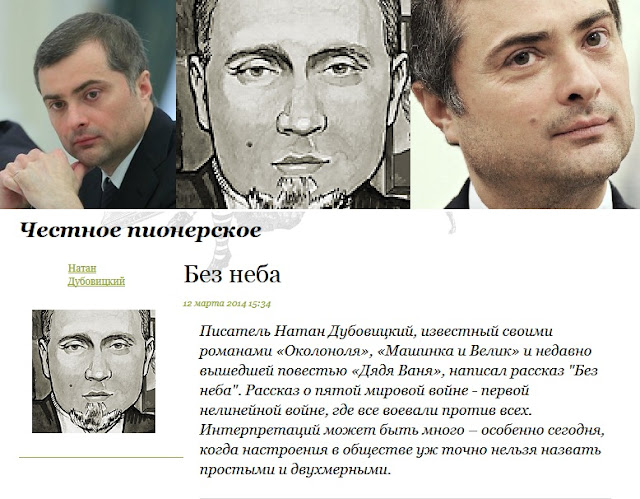
Collage by yours truly: Portraits of Vladislav Surkov (top left and top right) + a portrait of Natan Dubovitsky (top middle) + screenshot of the source of the latter portrait, with the intro to Dubovitsky's short story By Péter MARTON ** Join the European Science Fiction group on Facebook for related discussions. ** A friend sent along the link to this short story , titled "Without Sky" or Без неба in Russian. The author is indicated as Natan Dubovitsky -- a pseudonym. Keep this in mind for now. The Wikipedia page on none other than Vladislav Surkov says that "journalists in Russia and abroad have speculated that Surkov writes under the pseudonym Natan Dubovitsky, although the Kremlin denies it." If I look at the above collage, with two of Surkov's publicly available portraits and the drawn portrait of Natan Dubovitsky (from the site where the short story in question was published), I probably don't need a forensic investigation of the st...

Glukhovsky's Metro 2033 (3/3): Gender Issues

Image
We are here today to count the number of women on this book cover and beyond... By Péter MARTON ** Join the European Science Fiction group on Facebook for related discussions. ** One of the strenghts of the allegory in Glukhovsky's Metro 2033 is exactly what very probably would have been an obstacle to publishing this book in the US first. Because what all US editors encourage writers to include in their stories by default these days is... strong female characters (with some good reasons, at that). The number of strong female characters in Metro 2033 = 0 (zero). The reason is not chauvinism. To the contrary: through the absence of women, regardless of whether this is intentional or intuitive, the story demonstrates the importance of not standing in the way of women taking leading roles in the running of the world. In the subterranean universe, where man is often wolf to man, the sun doesn't shine, for it has no alternative. (See what I did there? H/t simul...

Glukhovsky's Metro 2033 (2/3): The Kremlin

Image
 Map of the Kremlin. Source (author: "Ludvig14") By Péter MARTON ** Join the European Science Fiction group on Facebook for related discussions. ** This is a very brief post, but with what may qualify as spoilers. The aim is to discuss one of the key metaphors in Glukhovsky's book. One that's not particularly sophisticated, but is very effective, and yet... goes unrecognised by many readers for what it is (especially by those enjoying the book on the superficial level of just following Artyom running around in the dark in his quest to make sense of his... quest). We learn about the Kremlin two important things in Metro 2033 :  Above the ground, the stars on top of the towers attract people who can't resist looking at them. In fact, this is no mere attraction: they are lured there. They keep staring and, imperceptibly to themselves, their feet deliver them to the being or thing that resides inside. If you're reminded of the Eye of Sauron, I gu...

Glukhovsky's Metro 2033 (1/3): The Stations, on Original Soviet Matchbox Label Art

Image
By Péter MARTON ** Join the European Science Fiction group on Facebook for related discussions. ** This will be the first today in a series of brief posts about things that make Dmitry Glukhovsky's 2005 novel Metro 2033 very interesting, and a must-have in the collection of all true fans of speculative fiction. (Yes, the matchbox label art is also there. Scroll down first if you wish, and then come back to read this.) The first reason I will name is the location. (To point out the obvious.) It's the Moscow Metro in the post-(nuclear)-apocalypse. A location that we, readers, along with chief protagonist Artyom and the rest of the survivors, are closed into. The plot traverses only around 25 stations - the full network consists today, as of 2018, of up to 14 lines and 245 stations over up to 419 kms ("up to," i.e. depending on how you count; note that the network has expanded since the writing of the book). In this dark new world, some of the stations a...

Review (#5): "Quarantine," a novelette by Yuriy Shcherbak (Kyiv, 1966)

Image
By Péter MARTON ** Join the European Science Fiction group on Facebook for related discussions. ** "Quarantine" ( Карантин in Ukrainian and Russian), a 1966 novelette by Yuriy Shcherbak, may be well worth a read even today. In this brief review I will give you a few good reasons for this, bullet point by bullet point, to keep my thoughts super-organised. Shcherbak is originally an epidemiologist, and as such he is the author or co-author of many scholarly papers.* Given this, when it comes to dealing with the medical and technological details of a story that begins with an incident in an early-era biosafety lab, it's like a walk in the park for him – he pulls it off without effort. He is also a pretty good writer, good at drawing characters, and providing insights about their merits and into their motives, simply by showing their actions and interactions unfold. In Quarantine , he is able to present a silent hero of humanism in chief researcher Balandin w...

Review (#4): "Utópia 501," an anthology published by Petőfi Literary Museum (Petőfi Irodalmi Múzeum, 2018)

Image
By Péter MARTON ** Join the European Science Fiction group on Facebook for related discussions. ** If you are a member of the European Science Ficton group on Facebook, you must have seen me share a link there to this recently-published digital anthology earlier on. "Utópia 501" is a collection of texts from various Central and Eastern European authors, rather loosely organised around the apropos of Thomas More's Utopia , published 501 years ago at the time when the idea of this anthology was born (and 502 years before its actual publication this year). Hence the illustration above: the left side features the cover art of More's original work from 1516, and on the right you have the cover of Utópia 501 . What follows is a brief review and a way to highlight some of the pieces included in the volume. As to the concept of the collection: it's not bad – I'm happy to see any idea that may inspire a publisher in Central Europe to think of publishing t...