Posts

Showing posts with the label Soviet Union

Mockumentaries...

Image
Scene from Pervye na Lune (First on the Moon) By Péter MARTON Just a quick piece on mockumentaries. I recently had the chance to watch two such films and it may be good to pass the information on in case you might have an interest in tracking them down, especially if you're a fan of the (sub)genre. One is Trollhunter , a Norwegian movie from 2010, described as dark fantasy by some, written and directed by André Øvredal. The other is Pervye na Lune/First on the Moon ( Первые на Луне ) from 2005, directed by Alex Fedorchenko -- an alternative history piece. Both films focus on conspiracies of different sorts: a benevolent one in the case of Norway where the conspiracy is keeping people protected, and a cynical one in the case of Russia where the mockumentary mentions even one of the interviewees appearing in it as having disappeared during the shooting of the documentary. (A documentary about a supposedly long-past event, at that, which was probably a way for the fi...
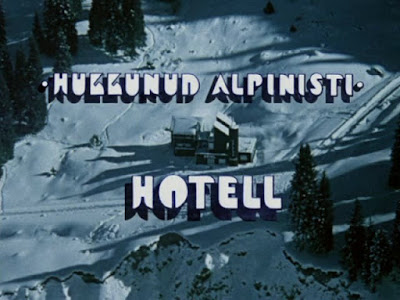

Dead Mountaineers' Hotel: Moralizing about a Soviet Officer's Duties

Image
Remote hotel resort, check. But this is not in Colorado – and not from The Shining . By Cseperke TIKÁSZ ** Join the  European Science Fiction group  on Facebook for related discussions. ** When  extraterrestrials arrive for an invasion and  superheros stand up to save the world, as in more than one such movie that we can remember, police usually get only a faceless supporting role. But not in  Dead Mountaineer’s Hotel,  a Soviet movie from the 1970s. Here we get to see an ordinary police officer's reaction to an encounter of this kind. In fact,  Dead Mountaineer’s Hotel  is a Soviet-Estonian movie. The story was written by the famous Strugatsky brothers (Boris and Arkady) and it was played by Estonian actors. The original copy is in Estonian, and it was only later dubbed to Russian by Lenfilm. Briefly, the plot features somewhere in the Alps a resort called Dead Mountaineer’s Hotel where our Inspector Glebsky arrive...

The Case of the Grey Eminence of the Red Kremlin with the Blue Ink

Image
Collage by yours truly: Portraits of Vladislav Surkov (top left and top right) + a portrait of Natan Dubovitsky (top middle) + screenshot of the source of the latter portrait, with the intro to Dubovitsky's short story By Péter MARTON ** Join the European Science Fiction group on Facebook for related discussions. ** A friend sent along the link to this short story , titled "Without Sky" or Без неба in Russian. The author is indicated as Natan Dubovitsky -- a pseudonym. Keep this in mind for now. The Wikipedia page on none other than Vladislav Surkov says that "journalists in Russia and abroad have speculated that Surkov writes under the pseudonym Natan Dubovitsky, although the Kremlin denies it." If I look at the above collage, with two of Surkov's publicly available portraits and the drawn portrait of Natan Dubovitsky (from the site where the short story in question was published), I probably don't need a forensic investigation of the st...

Glukhovsky's Metro 2033 (1/3): The Stations, on Original Soviet Matchbox Label Art

Image
By Péter MARTON ** Join the European Science Fiction group on Facebook for related discussions. ** This will be the first today in a series of brief posts about things that make Dmitry Glukhovsky's 2005 novel Metro 2033 very interesting, and a must-have in the collection of all true fans of speculative fiction. (Yes, the matchbox label art is also there. Scroll down first if you wish, and then come back to read this.) The first reason I will name is the location. (To point out the obvious.) It's the Moscow Metro in the post-(nuclear)-apocalypse. A location that we, readers, along with chief protagonist Artyom and the rest of the survivors, are closed into. The plot traverses only around 25 stations - the full network consists today, as of 2018, of up to 14 lines and 245 stations over up to 419 kms ("up to," i.e. depending on how you count; note that the network has expanded since the writing of the book). In this dark new world, some of the stations a...

Review (#7): "Gagarin: First in Space," a Movie Directed by Pavel Parkhomenko (2013)

Image
Gagarin is greeting Hungarian youth on the cover of a Hungarian newspaper, during a visit to Hungary, on August 26, 1961, exactly 57 years ago. His related handwritten message in Cyrillic may be seen beside his left leg. By Cseperke TIKÁSZ ** Join the European Science Fiction group on Facebook for related discussions. ** What did Yuriy Gagarin feel before his launch to space in 1961? What was Sergei Korolev (the chief Soviet spacecraft designer) thinking as the countdown proceeded? And what about German Titov, Gagarin's reserve? And Valentina Gagarina – the wife, with their two little daughters? We cannot possibly know, of course. What we know from the press coverage of the era is that an euphoric shock would soon be felt across the world, upon Gagarin's return, for Yuriy Gagarin, the first human to do so, has journeyed into outer space! In 2013, a new film on the subject was released in Russia: Gagarin: First in space (Гагарин. Первый в космосе). The production ...

Review (#6): Yuriy Shcherbak's "The Chronicle of Yaropol Town" (1968)

Image
A mural in Kyiv, Ukraine (the author's photo, 2016) By Péter MARTON ** Join the European Science Fiction group on Facebook for related discussions. ** Those following this blog will already know that I'm a fan of Yuriy Shcherbak – I praised him both as a writer and as a person (due to his parallel careers as epidemiologist scholar and writer, which he topped off with a role in politics and diplomacy in post-Soviet independent Ukraine).  It would be a let-down if I wouldn't write here about one of his best-known works, "The Chronicle of Yaropol Town" ( Хроніка міста Ярополя in Ukrainian). This was written after Quarantine , and takes Shcherbak and us way outside the world of the science lab. It is not genre stuff ( Quarantine wasn't that, either, of course), but it contains fantastic as well as SF elements. Shcherbak shows much technical skill here again in the sense of building complex and nicely written text, but apart from this his w...

Review (#2): "Lajko: Gipsy in Space", a Movie Directed by Balázs Lengyel (2018)

Image
By Péter MARTON This is a moderately spoilered review of the Hungarian movie " Lajkó: Cigány az űrben " (in our own translation: Lajko: Gipsy in Space ). Head to the cinemas first if you would like to form your own opinion of it, before reading a critical evaluation like this. And in the meantime, spend a last second marvelling at the art on the packaging of my favourite Russian chocolate ("Cosmic Odyssey") above , which is only loosely related, as illustration, to the subject of this post. Still here? Then let's talk, firstly, about key terms – because some people may be hesitant to watch this film upon encountering its title. Some think that "Gipsy" as a term is offensive, and perhaps "Roma" should be preferred as an alternative. What one then needs to realise is that there is nothing inherently offensive about the word Gipsy, and yet neither of the above terms is really fully appropriate. At different points in time, they were e...